
Artificial intelligence is rapidly becoming one of the most influential technologies in pharmaceutical research. What once required years of laboratory screening can now be supported by advanced machine learning models that help researchers identify promising drug candidates more efficiently.
Rather than replacing scientists, AI is becoming a powerful tool that assists researchers in analyzing biological data, predicting molecular behavior, identifying potential drug targets, and optimizing clinical development strategies.
As pharmaceutical companies continue investing billions of dollars in research and development, AI-driven platforms are helping improve productivity, reduce costs, and accelerate innovation across the healthcare industry.
Why AI Is Revolutionizing Drug Discovery
Developing a new medicine has traditionally been a long and expensive process. Researchers may evaluate thousands of chemical compounds before identifying one that is suitable for further development.
Modern AI platforms can assist researchers by:
- Identifying potential drug targets
- Predicting molecular interactions
- Analyzing genomic datasets
- Supporting biomarker discovery
- Improving clinical trial design
- Assisting with protein structure prediction
- Prioritizing promising compounds for laboratory testing
These capabilities help research teams make better-informed decisions while continuing to rely on laboratory validation and regulatory oversight.
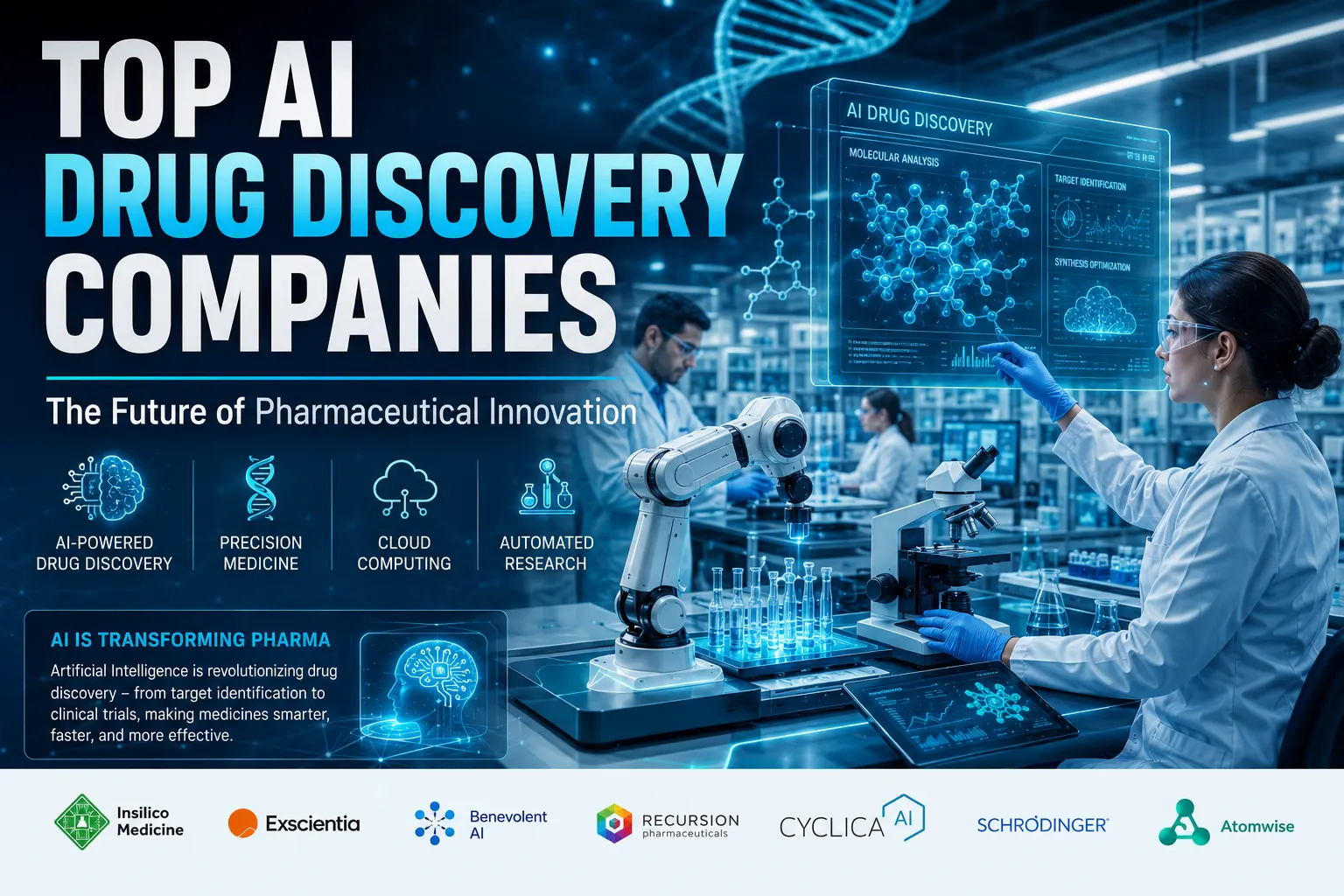
Top AI Companies in Drug Discovery
1. Isomorphic Labs
Focused on applying advanced AI to accelerate drug discovery and improve the understanding of complex biological systems.
2. Recursion
Uses machine learning, automation, and large biological datasets to support pharmaceutical research and therapeutic discovery.
3. Insilico Medicine
Known for combining generative AI with drug discovery platforms to help identify novel therapeutic candidates.
4. Exscientia
Develops AI-assisted drug design technologies in collaboration with pharmaceutical companies worldwide.
5. BenevolentAI
Applies artificial intelligence to biomedical data with the goal of identifying new treatment opportunities.
6. Atomwise
Uses deep learning to predict interactions between small molecules and proteins.
7. Schrödinger
Provides computational chemistry software widely used in pharmaceutical and biotechnology research.
8. XtalPi
Combines quantum physics, AI, and cloud computing to support pharmaceutical research.
9. Owkin
Uses machine learning to analyze medical data and advance precision medicine.
10. PathAI
Specializes in AI-powered pathology solutions that support diagnostics and biomedical research.
11. Tempus
Develops AI-driven precision medicine platforms using clinical and molecular data.
12. BioAge Labs
Uses computational biology and AI to support research into aging-related diseases.
13. Generate Biomedicines
Applies generative AI to protein engineering and therapeutic development.
14. Verge Genomics
Leverages machine learning to identify treatments for neurological diseases.
15. SandboxAQ
Focuses on AI and quantum technologies with applications across healthcare and life sciences.
Why Pharmaceutical Companies Are Investing in AI
Leading pharmaceutical companies are exploring AI because it can support multiple stages of research and development, including:
- Drug target identification
- Molecule optimization
- Clinical trial planning
- Medical imaging analysis
- Biomarker research
- Precision medicine initiatives
- Data analytics
- Pharmacovigilance support
AI does not replace scientific validation but can help researchers work more efficiently.
Career Opportunities
The growth of AI in life sciences is creating demand for professionals with interdisciplinary skills.
Popular roles include:
- AI Scientist
- Bioinformatics Scientist
- Machine Learning Engineer
- Computational Biologist
- Clinical Data Scientist
- AI Product Manager
- Medical Data Analyst
- Research Scientist
- Biostatistician
- Digital Health Specialist
Professionals who combine expertise in biology, chemistry, computer science, and data analysis are increasingly sought after.
Future Outlook
Artificial intelligence is expected to remain an important tool in pharmaceutical research. As computing power, biological datasets, and AI models continue to improve, researchers may discover new ways to support drug development and personalized medicine.
Successful innovation will continue to depend on rigorous scientific testing, ethical AI use, and regulatory compliance.
Conclusion
AI is reshaping pharmaceutical research by helping scientists analyze complex biological data and prioritize promising drug candidates more efficiently. While AI cannot replace laboratory research or clinical trials, it has become an important technology supporting the future of medicine.
Companies that combine advanced AI with strong scientific expertise are likely to play a significant role in the next generation of drug discovery.
FAQs
Can AI discover new medicines on its own?
No. AI supports researchers by analyzing data and generating insights, but laboratory testing, clinical trials, and regulatory review remain essential.
Which industries use AI in drug discovery?
Pharmaceutical companies, biotechnology firms, research institutions, healthcare organizations, and academic laboratories.
Is AI creating new pharma jobs?
Yes. Demand is growing for professionals with expertise in AI, bioinformatics, computational biology, and clinical data science.
Link this article to:
- Microbiologist Jobs 2026 | Agri Search Hiring for R&D Roles (Apply Before 15 July)
- TCS Pharmacovigilance Hiring 2026 | Mumbai Jobs (Job ID 420842)
- Dr. Reddy’s Semaglutide Supply Delay: What It Means for the Global GLP-1 Market in 2026
- GSK Graduate Intern 2026 | Regulatory Affairs (CMC RA) Jobs in Bengaluru for Freshers
- Advantmed Walk-In Drive 2026 | Medical Coding Jobs for Freshers in Gandhinagar (150 Openings)