
Preparing for a pharmaceutical production interview? If you’re a D.Pharm or B.Pharm fresher, understanding the basics of the Industry Production Department can significantly improve your chances of getting hired.
This guide covers the most commonly asked interview questions with simple answers to help you crack pharma interviews confidently.
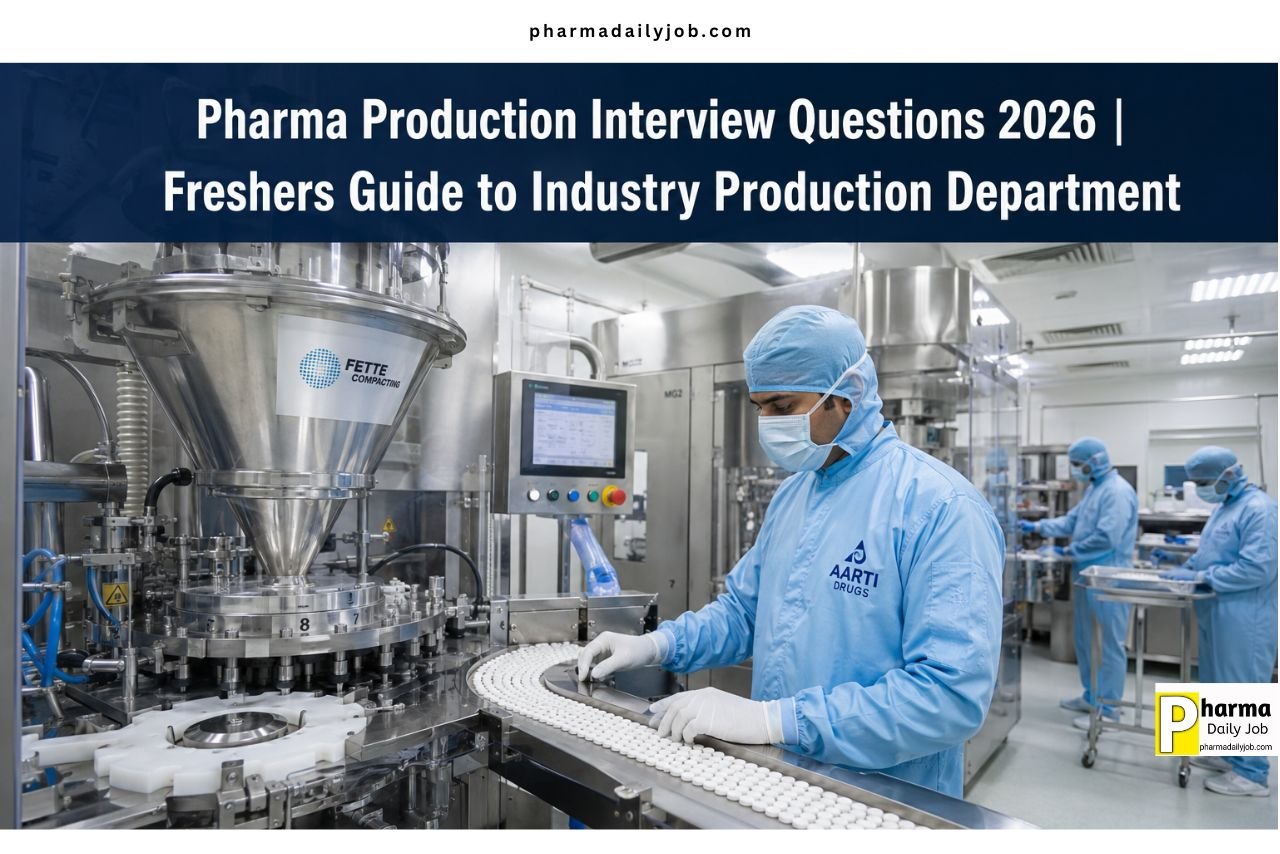
Pharmaceutical Production Environment Overview
The Production Department is the backbone of the pharmaceutical industry, responsible for manufacturing safe and effective medicines under strict GMP guidelines.
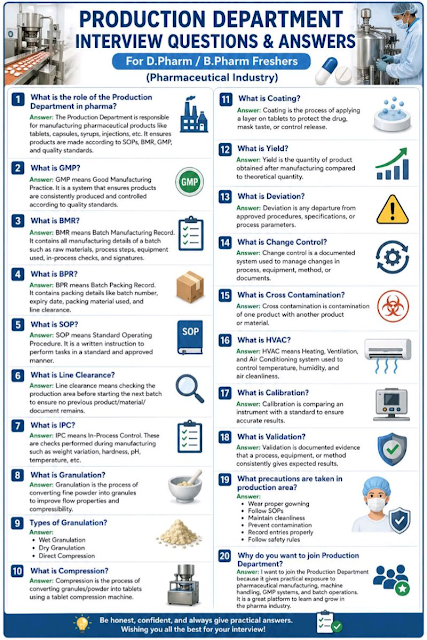
Top Industry Production Department Interview Questions & Answers
1. What is the role of the Production Department in pharma?
Answer: The Production Department manufactures pharmaceutical products like tablets, capsules, syrups, injections, and ointments while following approved procedures, SOPs, and GMP standards.
2. What is GMP?
Answer: GMP (Good Manufacturing Practice) ensures that products are consistently produced and controlled according to quality standards.
3. What is BMR?
Answer: Batch Manufacturing Record (BMR) contains complete manufacturing details of a batch including materials, processes, equipment, and operator records.
4. What is BPR?
Answer: Batch Packing Record (BPR) includes all packing-related details like batch number, packaging material, and labeling records.
5. What is SOP?
Answer: Standard Operating Procedure (SOP) is a written instruction describing how to perform a task correctly and consistently.
6. What is Line Clearance?
Answer: It ensures the production area is free from previous product materials, labels, or documents before starting a new batch.
7. What is IPC?
Answer: In-Process Control (IPC) involves checks like weight variation, hardness, pH, and moisture during production.
8. What is Granulation?
Answer: Granulation converts powder into granules to improve flow and compressibility.
Types:
- Wet Granulation
- Dry Granulation
- Direct Compression
9. What is Compression?
Answer: Compression is the process of converting granules into tablets using a compression machine.
10. What is Coating?
Answer: Coating adds a protective layer to tablets for taste masking, protection, or controlled drug release.
11. What is Yield?
Answer: Yield is the final output compared to theoretical output.
Formula: Yield (%) = (Actual Output / Theoretical Output) × 100
12. What is Deviation?
Answer: Any departure from approved procedures or specifications during manufacturing.
13. What is Change Control?
Answer: A system to evaluate and approve changes in processes, equipment, or documents.
14. What is Cross Contamination?
Answer: Unintended contamination of one product with another substance or product.
15. What is HVAC?
Answer: Heating, Ventilation, and Air Conditioning system that controls temperature, humidity, and air cleanliness in pharma areas.
16. What is Calibration?
Answer: Ensuring instruments provide accurate readings by comparing with standard references.
17. What is Validation?
Answer: Documented proof that processes and equipment consistently produce expected results.
18. What precautions should be taken in production?
Answer:
- Wear proper PPE
- Follow SOPs
- Maintain cleanliness
- Avoid contamination
- Record data properly
- Follow safety rules
- Report deviations
19. Why do you want to join the Production Department?
Sample Answer:
“I want to join the Production Department because it offers practical exposure to manufacturing processes, GMP systems, and machine operations, helping me build strong technical skills in the pharmaceutical industry.”
Pro Tips to Crack Pharma Production Interviews
- Revise GMP, SOP, and documentation concepts
- Understand basic manufacturing processes
- Be confident with practical examples
- Learn machine names and operations
- Prepare a strong self-introduction
FAQs
1. What is the Industry Production Department in pharma?
It is the department responsible for manufacturing medicines under strict quality and safety standards.
2. Which topics are important for pharma production interviews?
Key topics include GMP, SOP, BMR, BPR, IPC, HVAC, validation, and granulation.
3. Are these questions enough for freshers?
Yes, these are basic and frequently asked questions for entry-level pharma jobs.
4. How can I prepare for a production interview?
Focus on theoretical concepts, practical understanding, and communication skills.
5. Is production a good career in pharma?
Yes, it offers strong technical growth, industry exposure, and long-term career opportunities.