

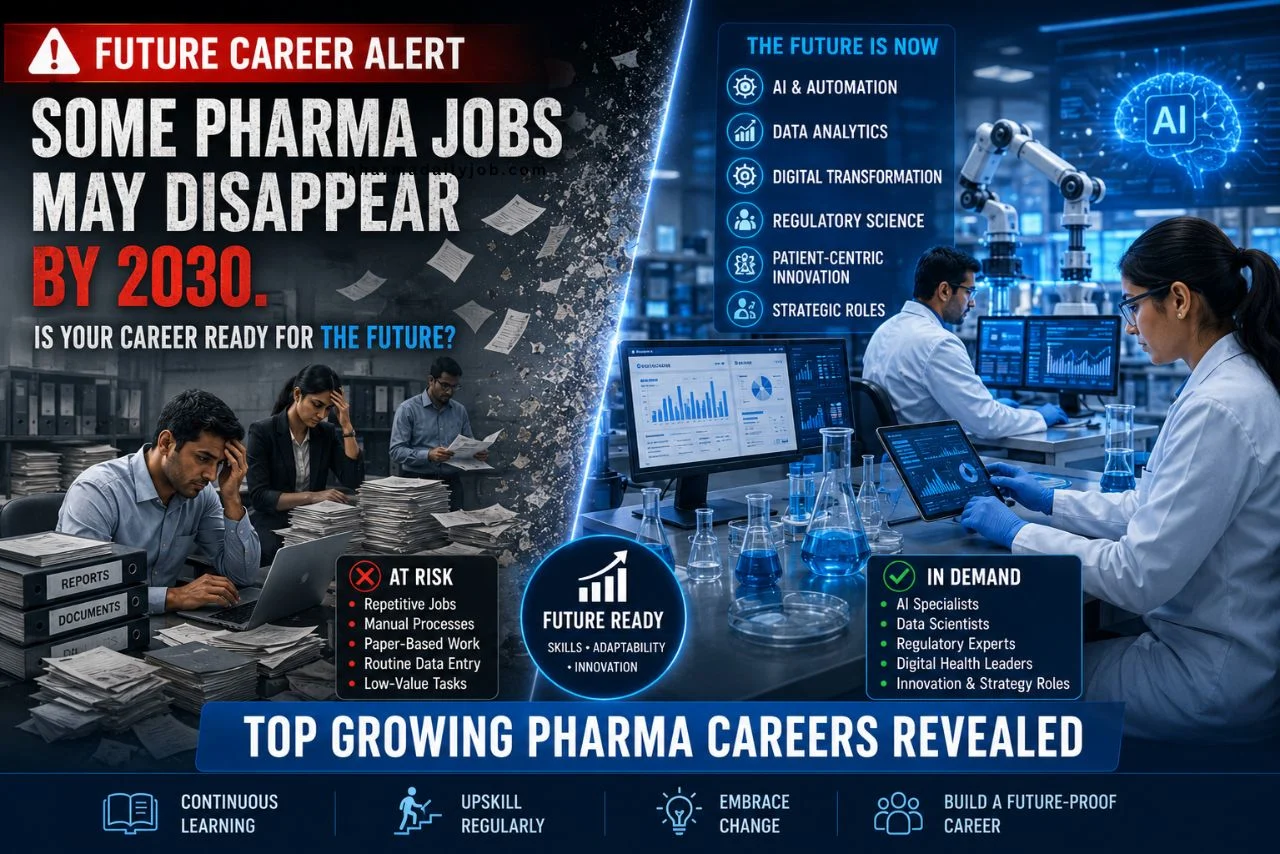
The pharmaceutical industry is changing faster than most professionals realize.
Artificial intelligence, automation, digital compliance systems, and advanced manufacturing technologies are transforming the way pharmaceutical companies operate.
Many professionals believe that their current role will remain unchanged for decades.
History suggests otherwise.
Industries evolve. Technology advances. Companies adapt.
And the professionals who prepare early often benefit the most.
The question isn’t whether the pharmaceutical industry will change.
The real question is:
Will your skills still be valuable in 2030?
The Wake-Up Call Many Professionals Ignore
A decade ago, many routine tasks required large teams.
Today, software can complete some of those activities faster, more accurately, and with fewer resources.
Pharmaceutical companies are increasingly investing in:
- Automation
- Digital documentation
- AI-assisted analytics
- Smart manufacturing
- Electronic quality systems
These changes are creating new opportunities while reducing the need for some repetitive tasks.
Pharma Roles Most Likely to Change
Let’s be clear.
This does not mean these jobs will completely disappear.
However, the way these roles operate may change dramatically.
1. Manual Documentation Roles
Companies are moving toward electronic documentation systems.
Professionals who only perform basic documentation tasks may face increasing competition from automated solutions.
2. Repetitive Data Entry Positions
Modern software can process large amounts of information quickly and accurately.
Employees who rely solely on routine data-entry activities may need additional skills to remain competitive.
3. Traditional Administrative Functions
Administrative responsibilities are becoming more digital and integrated.
Organizations increasingly value professionals who can contribute beyond basic administrative work.
The Pharma Careers Growing Rapidly
While some roles are changing, others are expanding faster than ever.
1. Regulatory Affairs
Regulatory requirements continue to become more complex worldwide.
Companies need experts who understand:
- Global regulations
- Product registrations
- Compliance strategies
- Regulatory submissions
This field is expected to remain highly valuable.
2. Pharmacovigilance
Drug safety is one of the most important priorities in healthcare.
As pharmaceutical products become more advanced, the need for safety monitoring continues to grow.
3. Clinical Research
New therapies, biologics, and personalized medicine are driving demand for clinical research professionals.
4. Data Integrity Specialists
Regulators place significant emphasis on accurate and reliable data.
Professionals who understand data integrity principles are increasingly valuable.
5. Validation and Qualification Experts
Modern pharmaceutical facilities rely heavily on validated systems, equipment, and processes.
Validation expertise continues to be highly sought after.
6. AI-Enabled Quality Professionals
Quality Assurance is evolving.
The future QA professional may combine GMP knowledge with digital systems and data analysis skills.
The Skills Employers Will Value Most
If you want to stay relevant in the future, focus on developing skills that technology cannot easily replace.
These include:
Critical Thinking
Companies need professionals who can evaluate situations and make informed decisions.
Regulatory Knowledge
Regulations continue to evolve, creating ongoing demand for compliance expertise.
Problem Solving
Organizations value employees who can identify issues and implement effective solutions.
Communication Skills
Strong communication remains one of the most powerful career advantages.
Leadership
Future leaders will be responsible for managing both people and technology.
A Career Story Worth Thinking About
Imagine two professionals starting their careers today.
The first focuses only on completing daily tasks.
The second continuously learns:
- GMP
- Data Integrity
- Regulatory Affairs
- Digital Systems
- Leadership Skills
Five years later, which professional is more likely to receive promotions, salary increases, and international opportunities?
The answer is obvious.
The difference often comes down to continuous learning.
Why Freshers Should Pay Attention
Many freshers focus only on getting their first job.
While landing a position is important, choosing the right direction is equally important.
The pharmaceutical industry of 2030 may look very different from the industry of today.
Freshers who build future-focused skills early can create significant advantages over their peers.
The Biggest Career Mistake You Can Make
The biggest mistake is assuming that the future will look exactly like the present.
Technology continues to evolve.
Regulations continue to change.
Business models continue to adapt.
Professionals who stop learning often find themselves struggling to keep up.
Those who continue developing their skills are more likely to thrive.
Final Thoughts
The pharmaceutical industry is entering a new era.
Some traditional tasks may become increasingly automated, but new opportunities are emerging just as quickly.
The future belongs to professionals who combine scientific knowledge, compliance expertise, digital awareness, and a commitment to lifelong learning.
The jobs of tomorrow are already taking shape today.
The only question is whether you are preparing for them.
FAQ
Will AI replace pharma jobs completely?
No. AI is more likely to transform jobs and workflows rather than completely replace most pharmaceutical professionals.
Which pharma careers have the strongest future?
Regulatory Affairs, Pharmacovigilance, Clinical Research, Validation, Data Integrity, and Quality Assurance are expected to remain important fields.
What skills should pharma freshers learn?
GMP, Data Integrity, Regulatory Affairs, Communication Skills, and Digital Systems knowledge can provide a strong foundation.
Is Regulatory Affairs a good long-term career?
Yes. Regulatory Affairs continues to be one of the most stable and high-growth areas in the pharmaceutical industry.
Link this article to:
- AI Is Changing Pharma Jobs in 2026: Will Your Career Survive the Next 5 Years?
- Pfizer Hiring Report Coordinator Associate 2026 | Hybrid Pharma Job in Chennai
- ECHS Pharmacist Recruitment 2026 – Government Job at Erode (₹36,500 Salary | Apply Before 15 June)
- AI Scientific Editor Work From Home Job 2026 | CACTUS Hiring Remote Editors in India
- Biovonic Healthcare Walk-In Drive 2026 | QA, QC, Production, Engineering Jobs in Jammu (Injectable Plant)