

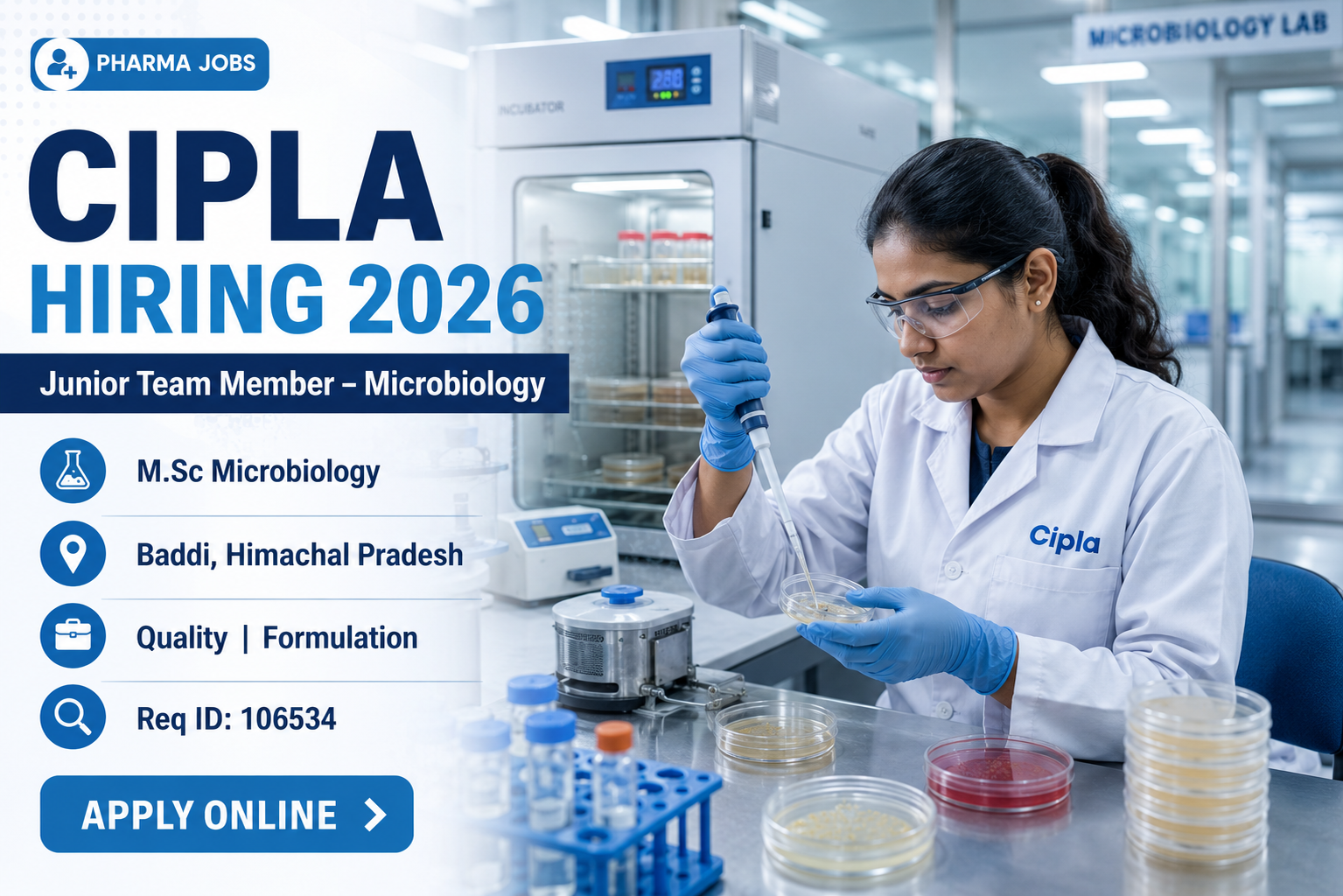
If you are an M.Sc Microbiology graduate looking for pharmaceutical jobs in Baddi, there is a fresh opportunity worth checking at Cipla Limited. Cipla’s official careers portal currently lists a Junior Team Member – Microbiology opening in Baddi, Himachal Pradesh, with a posting date of 31 August 2026 and requisition ID 106534. The position sits within the Formulation department and Quality business unit, making it particularly relevant for microbiologists who want to build a career in pharmaceutical quality control and laboratory operations.
What makes this vacancy interesting is that the role is not simply about performing laboratory tests and entering results into a system. Cipla’s official job description emphasizes reliable and reproducible analysis, reviewing microbiological results against specifications and methods, preparing reports, identifying abnormal observations, and supporting timely sample release. In other words, the microbiology professional becomes one of the important checkpoints between pharmaceutical manufacturing and the final quality decision. For someone who enjoys laboratory work but also wants exposure to GMP, documentation, quality systems, compliance, and manufacturing operations, this type of position can provide a strong foundation for long-term growth.
Cipla Recruitment 2026: What This Opportunity Means
The current Cipla vacancy is especially relevant because pharmaceutical manufacturing depends heavily on microbiological control. A medicine can meet its chemical specifications and still require rigorous microbiological evaluation depending on its dosage form, manufacturing environment, testing requirements, and applicable standards. That is why microbiology teams work closely with production, quality assurance, quality control, engineering, and other functions. The person performing the analysis is expected to generate dependable data that can support decisions within defined timelines, rather than simply completing an isolated laboratory experiment.
According to the official listing, the purpose of this position is to execute analysis of allocated samples and produce reliable, reproducible results so that microbiological quality parameters can be assessed against predefined specifications and standards. The job also involves reviewing data, preparing and submitting reports, reporting errors or abnormal observations, and supporting timely sample release. This gives applicants a useful clue about what Cipla is likely looking for: technical microbiology knowledge combined with discipline, documentation accuracy, analytical thinking, and the ability to work within a controlled pharmaceutical environment.
Why the Baddi Microbiology Role Matters
Baddi is an important pharmaceutical manufacturing location in Himachal Pradesh, and Cipla has maintained a manufacturing presence there for many years. Cipla’s own site information describes its Baddi unit as having been inaugurated in 2005, with manufacturing activities including tablets, hard gelatin capsules, pellets, rotacaps, and metered-dose inhalers. Working in such an environment can expose a microbiology professional to the practical relationship between laboratory testing and large-scale pharmaceutical manufacturing.
For a microbiologist, that environment can be very different from an academic laboratory. Instead of concentrating mainly on research questions, the focus is often on consistency, traceability, validated methods, controlled procedures, documentation, investigation, and compliance. Every result needs to be defensible, and every unexpected observation may need to be investigated according to established procedures. That makes a Junior Team Member role a potentially valuable stepping stone for candidates who eventually want to progress toward positions such as Team Member, Senior Team Member, microbiology analyst, microbiology specialist, QA/QC professional, or laboratory leadership roles.
A Quality-Focused Career in Pharmaceutical Manufacturing
A pharmaceutical microbiology career can be compared to the quality gate of a manufacturing system. Production teams manufacture the product, but microbiology professionals provide critical scientific information that helps demonstrate whether applicable microbiological requirements have been met. This is why attention to detail matters so much in the laboratory. A small documentation mistake, an unexplained abnormal result, or an incorrectly handled sample can create questions that extend far beyond the laboratory bench.
Cipla’s current job description specifically asks the successful candidate to analyze samples according to work allocation and priority, review data against specifications and microbiological methods, and prepare reports within stipulated timelines. These requirements show that the company is looking for someone who can balance technical accuracy with productivity. Candidates should therefore prepare to demonstrate not only what they learned during their M.Sc. but also how they would apply that knowledge responsibly in a regulated pharmaceutical setting.
Cipla Company Overview
Cipla is a major global pharmaceutical company whose stated purpose is “Caring for Life.” Its official corporate website currently reports 48 manufacturing sites, more than 50 dosage forms, over 1,500 products, and operations across 69 markets. That scale matters for job seekers because a role inside a large pharmaceutical organization can provide exposure to structured processes, standardized systems, cross-functional collaboration, and regulated manufacturing practices.
Cipla’s FY2025-26 annual report also describes an extensive manufacturing ecosystem and reports annual production figures across multiple dosage categories, including tablets and capsules, respules, lyophilised injections, oral liquids, nasal sprays, metered-dose inhalers, dry powder inhalers, and APIs. The report states that the company has embedded a technology-enabled quality culture across its facilities. For microbiology candidates, this reinforces the importance of understanding that laboratory quality is connected to the broader manufacturing and patient-safety ecosystem.
Cipla’s Manufacturing and Quality Network
Cipla’s manufacturing network includes Baddi among its Indian manufacturing locations, and the company has publicly described its Baddi facility as a significant manufacturing site. A microbiology professional working at such a site can potentially interact with manufacturing processes, laboratory systems, quality documentation, environmental controls, sample management, and other activities governed by pharmaceutical procedures.
Cipla also highlights employee development and career growth as part of its people strategy. Its FY2025-26 reporting says the company strengthened performance management through goal alignment, real-time check-ins, 360-degree feedback, career aspiration reviews, and self-development goals. The same report says 83% of employees participated in its annual engagement survey, producing an engagement score of 92%. These company-level indicators do not guarantee a particular career outcome for an individual employee, but they provide useful context for candidates evaluating the organization.
Cipla Junior Team Member Microbiology Job Details
The most important vacancy details can be summarized clearly so candidates can verify them before applying.
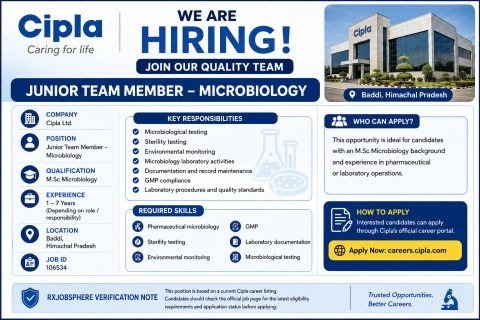
| Job Detail | Information |
|---|---|
| Company | Cipla Limited |
| Position | Junior Team Member – Microbiology |
| Department | Formulation |
| Business Unit | Quality |
| Location | Baddi, Himachal Pradesh |
| Country | India |
| Qualification | M.Sc Microbiology |
| Req ID | 106534 |
| Posting Date | 31 August 2026 |
| Primary Focus | Microbiological sample analysis and quality compliance |
These details come from Cipla’s official careers listing rather than a third-party job aggregation page. Candidates should always verify that the vacancy is still active on the official career portal before submitting an application because recruitment listings can change or close without much notice.
Educational Qualification and Experience
The vacancy information supplied for this recruitment identifies M.Sc Microbiology as the relevant educational qualification. The opportunity is therefore particularly suitable for postgraduate microbiology candidates who want to enter or continue working in pharmaceutical quality operations. The supplied vacancy details also indicate an experience range of 1 to 7 years, although candidates should rely on the live official listing for the current eligibility wording and application status.
Who Should Apply for This Microbiology Job?
The strongest applicants are likely to be people who can connect academic microbiology with practical pharmaceutical laboratory work. If you have experience with microbiological testing, sample handling, laboratory documentation, controlled procedures, environmental monitoring, sterility-related activities, or pharmaceutical quality systems, those experiences can help you present a stronger application. Fresh postgraduate knowledge can also be valuable, but candidates should avoid listing techniques on a resume unless they genuinely understand or have performed them.
Applicants should also understand that a regulated laboratory is not the same as a college practical laboratory. In a pharmaceutical environment, documentation, traceability, data integrity, procedural compliance, and timely reporting are as important as technical execution. A candidate who can explain why a particular test is performed, how results are reviewed, what could cause an abnormal result, and how deviations should be handled will generally communicate much more effectively during an interview than someone who only memorizes definitions.
Junior Team Member – Microbiology Job Description
The official Cipla listing describes the position as responsible for analyzing allocated samples and generating reliable and reproducible microbiological results. The candidate is expected to work according to sample priority and allocation, review data against applicable specifications and microbiological methods, and prepare reports for the Team Leader within defined timelines. This indicates that the job combines laboratory execution with review and reporting responsibilities.
The role also requires professionals to communicate errors, abnormal observations, and non-compliances related to procedures, equipment, and instruments. That is a significant part of pharmaceutical quality culture because laboratory personnel should not ignore an unexpected result simply because it creates additional work. Instead, unusual observations need to be recognized, documented, escalated, and handled through the appropriate procedure. Candidates interviewing for this role should therefore be comfortable discussing situations where they identified an error or unexpected laboratory observation and explain how they responded responsibly.
Sample Analysis and Microbiological Testing
Microbiology testing in pharmaceutical manufacturing can involve a variety of activities depending on the facility, product, approved methods, and applicable standards. Candidates should revise fundamental concepts such as microbial enumeration, microbial limits, sterility testing principles, environmental monitoring, growth promotion, media preparation, aseptic practices, contamination control, microbial identification concepts, and laboratory documentation. They should also understand why controls are necessary and why test conditions must be carefully maintained.
It is important not to assume that every microbiology job involves exactly the same test menu. The actual responsibilities depend on the manufacturing site and the samples assigned to the laboratory. Cipla’s current listing specifically emphasizes sample analysis, data review, reporting, abnormal observation reporting, and timely support for sample release, so applicants should prepare around those core responsibilities rather than attempting to memorize every possible microbiological technique.
Key Responsibilities in the Microbiology Laboratory
A successful Junior Team Member should expect a role where accuracy and consistency are central. The official job description states that samples must be analyzed according to work allocation and priority, while results must be reviewed against the relevant specifications and microbiological methods. This means candidates need organizational skills as well as laboratory knowledge because multiple samples or activities may have competing timelines.
Another important responsibility is reporting. Results are useful only when they are properly recorded, reviewed, communicated, and retained according to the applicable system. A professional who notices a potential issue but fails to report it can create a much larger quality risk than someone who promptly escalates the observation. That is why interviewers may be interested in examples demonstrating your attention to detail, willingness to follow SOPs, ability to work under pressure, and judgment when something does not look normal.
GMP, Documentation and Compliance Expectations
Good Manufacturing Practice, or GMP, is one of the most important areas for anyone entering pharmaceutical microbiology. GMP is not simply a collection of rules to memorize for an interview; it is a way of working that helps ensure medicines are consistently manufactured and controlled according to defined quality requirements. In a laboratory, that mindset appears through controlled procedures, equipment qualification and maintenance, appropriate documentation, sample traceability, method adherence, data review, investigation of unexpected results, and proper handling of records.
Cipla’s current position explicitly connects microbiological analysis with predefined quality parameters and standards, while its responsibilities include reporting errors, abnormal observations, and non-compliances. Candidates should therefore revise practical concepts such as ALCOA+ data integrity principles, SOP compliance, deviation handling, OOS/OOT concepts, contamination control, documentation practices, and laboratory safety. Even if every topic is not directly tested, being able to explain the reasoning behind pharmaceutical quality practices can make an interview response considerably stronger.
Skills That Can Help You Get Selected
Technical knowledge is only one part of a strong microbiology application. Employers also need people who can work carefully within a team, prioritize samples, communicate unexpected findings, maintain records, and meet defined timelines. Cipla’s job description makes these expectations visible through its emphasis on sample priority, data review, reporting, abnormal observations, and timely sample release.
For your resume, focus on evidence rather than vague claims. Instead of simply writing “knowledge of microbiology,” describe relevant laboratory exposure and techniques you genuinely know. If you have worked with environmental monitoring, sterility testing, microbial analysis, media preparation, aseptic practices, documentation, or pharmaceutical laboratory instruments, explain your involvement accurately. A focused one- or two-page resume is usually more useful than a long document filled with unrelated academic information.
Career Growth After Joining Cipla
A Junior Team Member position can serve as an entry point into the wider pharmaceutical quality ecosystem. With appropriate experience and performance, a microbiology professional may develop toward roles involving greater technical responsibility, laboratory coordination, investigation, documentation review, quality systems, or people management. The exact career path depends on performance, organizational requirements, vacancies, qualifications, and individual development, so candidates should treat progression as an opportunity rather than a guaranteed promotion ladder.
Cipla’s FY2025-26 reporting describes career aspiration reviews and self-development goals as part of its performance-management approach. That makes continuous learning especially relevant for someone joining a regulated laboratory. A professional who builds strong fundamentals in microbiological testing while simultaneously learning GMP, data integrity, investigation methodology, documentation systems, and cross-functional communication can create a much stronger long-term profile than someone who focuses only on routine testing.
Why Work at Cipla Baddi?
For candidates interested in pharmaceutical manufacturing, Baddi provides an environment where laboratory science connects directly with industrial production. Cipla’s Baddi information identifies the site as a manufacturing facility producing several dosage forms, while the current vacancy places the microbiology position within the Formulation and Quality structure. That combination makes the role relevant to professionals who want practical exposure to pharmaceutical quality operations rather than a purely academic microbiology position.
Cipla’s corporate information also emphasizes its people and describes employees as an important part of its long-term success. Its latest annual reporting says the company has continued to invest in performance management, career development, employee engagement, and workplace practices. For a job seeker, these are useful signals when evaluating the broader organization, although the actual experience of an employee will naturally depend on the team, manager, site, function, and individual circumstances.
Salary, Benefits and Other Perks
The current official listing does not provide a specific salary figure in the information available on the job page, so candidates should avoid relying on unverified salary numbers circulating on social media or job portals. Compensation can vary according to experience, internal grade, location, and company policy. The safest approach is to discuss compensation through the formal recruitment process if the employer reaches the relevant stage.
Candidates should also avoid treating a job advertisement as a promise of specific benefits unless those benefits are explicitly confirmed by Cipla. Large pharmaceutical organizations can provide structured learning, professional development, workplace programs, and opportunities for career growth, but the exact benefits applicable to an employee should be confirmed during recruitment. Cipla’s latest annual report does document structured performance and career-development processes, including goal alignment and career aspiration reviews.
How to Apply for Cipla Jobs in Baddi
The best approach is to apply through Cipla’s official careers portal, where the current vacancy is listed under Req ID 106534. The official job page identifies the position as Junior Team Member – Microbiology, with Baddi as the location and 31 August 2026 as the posting date.
Apply through Cipla’s official Junior Team Member – Microbiology listing
Before applying, update your resume and ensure that your qualification, relevant experience, technical skills, and contact information are accurate. Use a professional file name, check spelling carefully, and make sure your resume does not contain exaggerated skills. If you are applying with pharmaceutical experience, highlight your microbiology responsibilities rather than burying them under a long list of unrelated duties.
Application Checklist for Candidates
Before clicking the application button, candidates should verify a few basic points. First, confirm that your educational qualification matches the vacancy and that your experience is relevant to the position. Second, review your resume against the job description and make sure the most relevant microbiology and quality-related skills are easy to find.
- Qualification: M.Sc Microbiology.
- Location: Baddi, Himachal Pradesh.
- Position: Junior Team Member – Microbiology.
- Req ID: 106534.
- Posting date: 31 August 2026.
- Important preparation areas: microbiological testing, GMP, documentation, data review, laboratory compliance, and abnormal-result reporting.
- Application route: Cipla’s official careers website.
Interview Preparation for Cipla Microbiology Jobs
If you receive an interview call, prepare for a combination of technical and situational questions. Technical questions may explore microbiology fundamentals, pharmaceutical microbiology, environmental monitoring, sterility concepts, contamination control, laboratory practices, GMP, documentation, and data integrity. Situational questions may ask what you would do if you observed an unexpected result, discovered a documentation error, found an equipment issue, or were under pressure to complete testing within a defined timeline.
A good preparation strategy is to practice explaining your answers rather than memorizing paragraphs. For example, if asked about an abnormal microbiological result, demonstrate that you understand the importance of stopping and assessing the situation according to applicable procedures, documenting observations, notifying the appropriate person, and following the approved investigation process. The exact action will always depend on the SOP and circumstances, but the interviewer is often trying to understand whether you naturally think in terms of quality, compliance, scientific evidence, and patient safety.
Common Mistakes Candidates Should Avoid
One of the biggest mistakes is applying with a generic resume that does not communicate microbiology experience clearly. Another is claiming familiarity with techniques that the candidate cannot explain when questioned. Pharmaceutical interviews can quickly reveal the difference between someone who has genuinely worked with a process and someone who has simply copied keywords from a job description.
Candidates should also avoid treating GMP as a memorization exercise. If you know the definition but cannot explain why documentation, traceability, controlled procedures, and investigation matter, your interview answers may sound theoretical. Finally, never ignore the importance of communication: the official role specifically includes reporting errors, abnormal observations, and non-compliances, so demonstrate that you understand the responsibility to escalate quality-related concerns promptly.
Important Recruitment Fraud Warning
Job seekers should be especially careful with recruitment scams. Cipla itself warns candidates that unauthorized individuals and recruitment agencies may impersonate Cipla or its group companies, use fraudulent offer letters, and request money or security deposits. Cipla states that it follows a formal recruitment process through its own HR department and warns candidates about such fraudulent activity.
A genuine candidate should therefore verify the vacancy on Cipla’s official career platform before trusting messages received through WhatsApp, Telegram, social media, or unofficial email accounts. Never pay money for an interview, job offer, appointment letter, background check, or recruitment processing fee simply because someone claims to represent Cipla. When in doubt, return to the official careers portal and verify the position rather than relying on a forwarded screenshot.
Conclusion
The Cipla Junior Team Member – Microbiology vacancy in Baddi is a relevant opportunity for M.Sc Microbiology professionals interested in pharmaceutical quality and laboratory operations. The official posting dated 31 August 2026 identifies Baddi as the location, the Formulation department and Quality business unit as the organizational area, and Req ID 106534 as the recruitment reference. The role centers on sample analysis, reliable and reproducible microbiological results, data review, reporting, abnormal-observation escalation, and supporting timely sample release.
For candidates, the message is simple: do not approach this opportunity as just another laboratory vacancy. Prepare around pharmaceutical microbiology, GMP, documentation, data integrity, laboratory discipline, communication, and quality-focused decision-making. A well-targeted resume combined with strong technical preparation can help you present yourself more effectively. Most importantly, apply through Cipla’s official careers channel and verify the vacancy before sharing personal information or responding to anyone claiming to guarantee employment.
Frequently Asked Questions
Is M.Sc Microbiology mandatory for this Cipla position?
The current official vacancy identifies M.Sc Microbiology as the relevant qualification for the Junior Team Member – Microbiology position. Candidates should still review the live official listing before applying because recruitment requirements can be updated.
What is the job location and requisition number?
The position is based in Baddi, Himachal Pradesh, and the official Cipla listing gives the requisition ID as 106534. The posting date shown on the official page is 31 August 2026.
What kind of work will the selected candidate perform?
The role involves analyzing allocated samples, reviewing microbiological data against applicable specifications and methods, preparing reports, reporting errors or abnormal observations, and supporting timely sample release.
Can experienced microbiology professionals apply?
The supplied vacancy information indicates an experience range of 1 to 7 years, making the opportunity relevant to microbiology professionals with applicable pharmaceutical or laboratory experience. Candidates should verify the exact current eligibility criteria on the official job page before applying.
Where should candidates apply for this vacancy?
Candidates should use Cipla’s official careers portal and search for Junior Team Member – Microbiology, Baddi, Req ID 106534.