
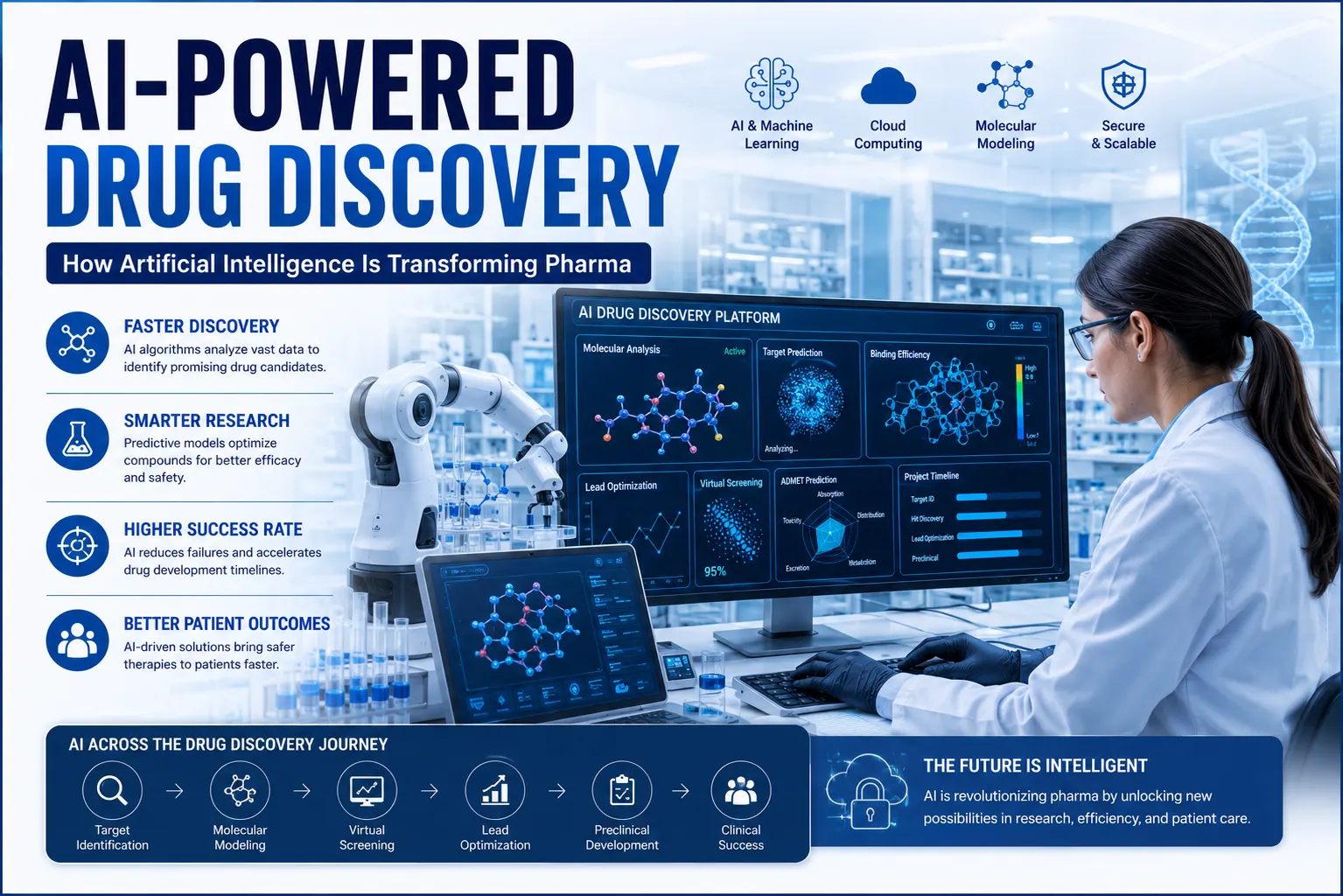
Artificial Intelligence (AI) is no longer just a buzzword in the technology sector—it has become one of the most important forces driving innovation in the pharmaceutical industry. From identifying promising drug candidates to improving clinical trial efficiency, AI is helping researchers analyze massive amounts of scientific data in ways that were previously impossible.
Major pharmaceutical companies including Pfizer, AstraZeneca, Roche, Sanofi, Novartis, Merck, Bristol Myers Squibb, Eli Lilly, and Johnson & Johnson are investing heavily in AI-driven research. At the same time, technology companies such as Microsoft, Google, Amazon Web Services, and NVIDIA are partnering with healthcare organizations to accelerate medical innovation.
As global healthcare challenges continue to evolve, AI-powered drug discovery is expected to remain one of the fastest-growing areas of biotechnology over the next decade.
What Is AI-Powered Drug Discovery?
Traditional drug discovery is a lengthy and expensive process that can take many years from the initial research stage to regulatory approval.
Artificial intelligence helps researchers by analyzing enormous datasets much faster than conventional methods. AI systems can identify patterns in biological data, predict molecular behavior, and prioritize the most promising compounds for laboratory testing.
It’s important to note that AI does not replace laboratory research, clinical trials, or regulatory review. Instead, it supports scientists by improving efficiency and helping them make data-driven decisions.
Why Big Pharma Is Investing Billions in AI
The pharmaceutical industry faces increasing pressure to develop safer and more effective medicines while managing research costs.
AI offers several potential advantages:
- Faster identification of promising drug candidates
- Improved analysis of biological and genomic data
- Better clinical trial planning
- Enhanced patient recruitment strategies
- Predictive safety analysis
- More efficient research workflows
These capabilities may reduce development timelines for certain research activities, although every medicine must still undergo rigorous testing before reaching patients.
AI Applications Across the Drug Development Process
Artificial intelligence is being explored across nearly every stage of pharmaceutical research.
1. Target Identification
AI can analyze scientific literature, genetic databases, and biological pathways to identify potential drug targets associated with specific diseases.
2. Molecule Design
Machine learning models can help researchers evaluate millions of chemical structures and identify compounds with promising characteristics for further investigation.
3. Clinical Trial Optimization
AI may support clinical research by:
- Identifying suitable study sites
- Improving patient recruitment
- Monitoring data quality
- Predicting enrollment challenges
- Optimizing trial design
These applications can improve operational efficiency while maintaining scientific standards.
4. Drug Safety Monitoring
Pharmacovigilance teams increasingly use AI-assisted tools to analyze safety reports, detect trends, and prioritize potential signals for expert review.
Human oversight remains essential, particularly for regulatory reporting and medical assessment.
5. Manufacturing and Supply Chain
AI is also being used to:
- Improve production planning
- Monitor equipment performance
- Predict maintenance needs
- Optimize inventory management
- Strengthen pharmaceutical supply chains
Benefits for Patients
Although AI operates largely behind the scenes, patients may benefit through:
- Faster medical research
- More personalized treatment approaches
- Improved clinical trial efficiency
- Better medicine safety monitoring
- Continued innovation in healthcare
Any new medicine developed with AI support must still meet the same regulatory standards for safety, quality, and effectiveness.
Challenges and Ethical Considerations
Despite its potential, AI in healthcare presents important challenges.
Organizations must carefully address:
- Patient privacy
- Data security
- Algorithm transparency
- Bias in AI models
- Regulatory compliance
- Human oversight
Responsible AI implementation requires collaboration between scientists, healthcare professionals, regulators, and technology experts.
Career Opportunities in AI-Powered Pharma
As pharmaceutical companies continue expanding AI capabilities, demand is growing for professionals in:
- Artificial Intelligence Engineering
- Data Science
- Bioinformatics
- Computational Biology
- Clinical Data Management
- Regulatory Affairs
- Pharmacovigilance
- Medical Writing
- Quality Assurance
- Digital Health
- Machine Learning Engineering
- Cloud Computing
- Healthcare Analytics
Professionals with expertise in both life sciences and technology are increasingly valuable across the industry.
Which Pharmaceutical Companies Are Leading AI Adoption?
Several global pharmaceutical companies have announced AI initiatives, collaborations, or investments, including:
- Pfizer
- Novartis
- Roche
- AstraZeneca
- Sanofi
- Eli Lilly
- Merck
- Bristol Myers Squibb
- Johnson & Johnson
- GSK
Technology providers such as Microsoft, Google, NVIDIA, and Amazon Web Services also play an important role by supplying cloud infrastructure and AI platforms that support healthcare research.
Official Sources
- U.S. Food and Drug Administration (FDA): https://www.fda.gov
- National Institutes of Health (NIH): https://www.nih.gov
- Microsoft Healthcare: https://www.microsoft.com/industry/health
- Google DeepMind: https://deepmind.google
- NVIDIA Healthcare & Life Sciences: https://www.nvidia.com/en-us/industries/healthcare-life-sciences/
Future Outlook
AI is expected to become an even more important tool in pharmaceutical research over the coming years.
Future developments may include:
- More accurate disease prediction models
- Advanced molecular simulations
- Smarter clinical trial management
- AI-assisted precision medicine
- Improved manufacturing automation
- Better integration of real-world health data
While AI will continue to accelerate research, scientific validation, clinical evidence, and regulatory oversight will remain essential before new treatments become available.
Conclusion
Artificial intelligence is transforming the pharmaceutical industry by helping researchers analyze complex data, improve research efficiency, and support drug discovery. Rather than replacing scientists, AI serves as a powerful tool that complements human expertise.
As investment in AI continues to grow, pharmaceutical companies, biotechnology firms, and healthcare organizations are likely to develop new ways to improve research, streamline clinical development, and enhance patient care.
The future of medicine will depend not only on breakthrough discoveries but also on the responsible use of technologies that support innovation while maintaining the highest standards of safety, ethics, and scientific integrity.
Frequently Asked Questions
What is AI-powered drug discovery?
AI-powered drug discovery uses artificial intelligence to help researchers analyze scientific data, identify potential drug candidates, and support various stages of pharmaceutical research.
Can AI create new medicines on its own?
No. AI assists researchers by analyzing data and generating insights, but laboratory testing, clinical trials, and regulatory review remain essential.
Which companies are investing in AI for healthcare?
Many pharmaceutical and technology companies—including Pfizer, Novartis, Roche, Eli Lilly, Microsoft, Google, and NVIDIA—have announced AI-related healthcare initiatives.
Is AI replacing pharmaceutical scientists?
No. AI is designed to support researchers and healthcare professionals, not replace their scientific expertise or decision-making.
Link this article to:
- BioClinAarc Pharmacovigilance Jobs 2026: PV, Medical Review & PSUR Openings
- Deccan Fine Chemicals Walk-In Interview 2026: Production Chemist Jobs for Freshers & Experienced
- Subros Limited Walk-In Interview 2026: Engineering, Production & Multiple Job Openings in Ahmedabad
- Lactose India Limited Jobs 2026: Process & Product Development Roles in Vadodara
- Farbe Firma Pharma Jobs 2026: QA, QC, Production & Engineering Roles in Ankleshwar
- Gland Pharma Walk-In Interview 2026: Production Chemist Jobs in Hyderabad