

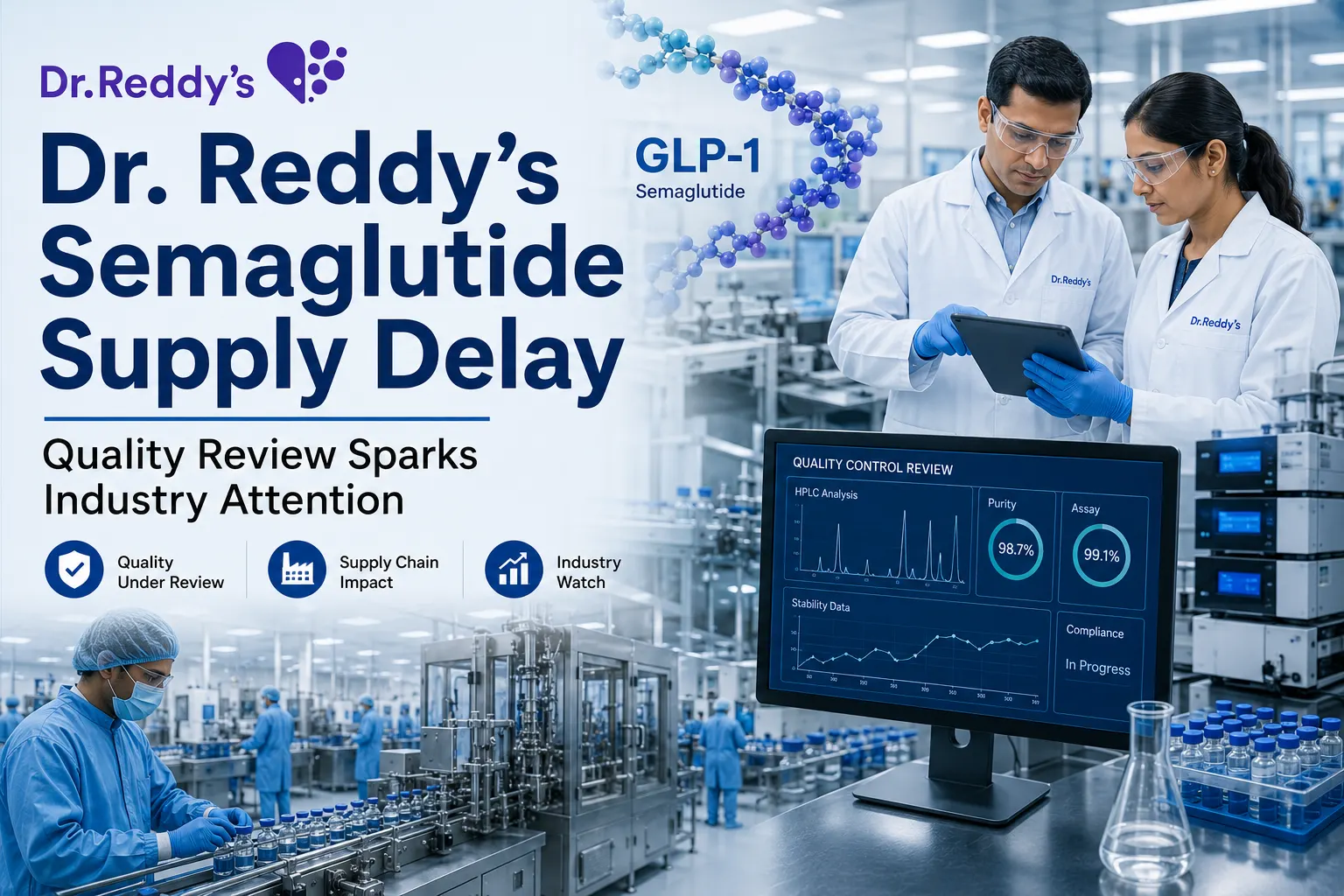
The global race to expand access to GLP-1 medicines has reached another important milestone after Dr. Reddy’s Laboratories announced a temporary delay in commercial supplies of its semaglutide products. The company said the delay was caused by an issue involving the active pharmaceutical ingredient (API) used in certain production batches. According to the company, some batches did not meet quality specifications during manufacturing, leading to a pause in commercial supplies while the root cause is investigated. The company also stated that there is no impact on patient safety or its existing global regulatory filings.
Why This News Matters
Semaglutide is one of the world’s fastest-growing pharmaceutical products and is widely known for its use in approved treatments for type 2 diabetes and chronic weight management in eligible patients. Demand for GLP-1 medicines has increased significantly over the past few years, encouraging pharmaceutical companies worldwide to invest in manufacturing capacity and product development.
Because of this strong demand, any disruption in the supply chain immediately attracts attention from healthcare professionals, investors, manufacturers, and patients.
What Caused the Delay?
Dr. Reddy’s explained that certain batches of semaglutide were found to be outside the required quality specifications because of an issue related to the API. As a result, commercial supplies have been delayed while the company investigates the cause and implements corrective actions. The company emphasized that the issue does not affect patient safety and that its existing regulatory filings remain unchanged.
Quality control is a critical part of pharmaceutical manufacturing. When a product does not meet established quality standards, companies typically suspend distribution until they identify the root cause and complete any necessary corrective measures.
Impact on the GLP-1 Market
Although the delay affects one manufacturer’s supply plans, it also highlights how competitive and technically demanding the GLP-1 market has become.
Industry analysts continue to view obesity and diabetes therapies as major growth areas for pharmaceutical companies. Manufacturers are investing heavily in production facilities, research, quality systems, and global supply chains to meet increasing demand.
Temporary manufacturing delays can influence business strategies, but long-term market growth will continue to depend on innovation, manufacturing quality, regulatory compliance, and patient demand.
Career Opportunities
The continued expansion of the GLP-1 market is creating opportunities across the pharmaceutical industry, including:
- Production & Manufacturing
- Quality Assurance (QA)
- Quality Control (QC)
- Regulatory Affairs
- Pharmacovigilance
- Process Engineering
- Supply Chain Management
- Validation
- Analytical Research
- Medical Affairs
Professionals with expertise in GMP, regulatory compliance, analytical testing, and pharmaceutical manufacturing are expected to remain in demand as companies continue investing in metabolic disease therapies.
Industry Outlook
The global GLP-1 market remains one of the most closely watched sectors in healthcare. Pharmaceutical companies are developing new therapies, increasing manufacturing capacity, and expanding into additional international markets.
While temporary production challenges are part of pharmaceutical manufacturing, maintaining product quality and patient safety remains the industry’s highest priority. Regulatory agencies require manufacturers to meet strict quality standards before products reach patients.
Final Thoughts
Dr. Reddy’s announcement demonstrates the importance of robust quality systems in pharmaceutical manufacturing. Although commercial supplies have been delayed, the company has stated that patient safety is not affected and that it is working to resolve the issue before resuming supply. As demand for GLP-1 medicines continues to grow, manufacturers that maintain strong quality standards and reliable production capabilities will be well positioned for long-term success.
Link this article to:
- Covalent Laboratories Walk-In Interview 2026 | Freshers & Experienced Jobs in Hyderabad
- Strides Walk-In Interview 2026 | Engineering & Packing Jobs in Bangalore (2–8 Years)
- Ind-Swift Laboratories Walk-In 2026 | QA & QC Jobs (Officer to Executive) – 12 July
- Spectrasynth Pharmachem Hiring 2026 | Analytical Jobs in Ahmedabad for M.Sc Chemistry (5–8 Years)
- Strides Walk-In Interview 2026 | Engineering & Packing Jobs in Bangalore (2–8 Years)