
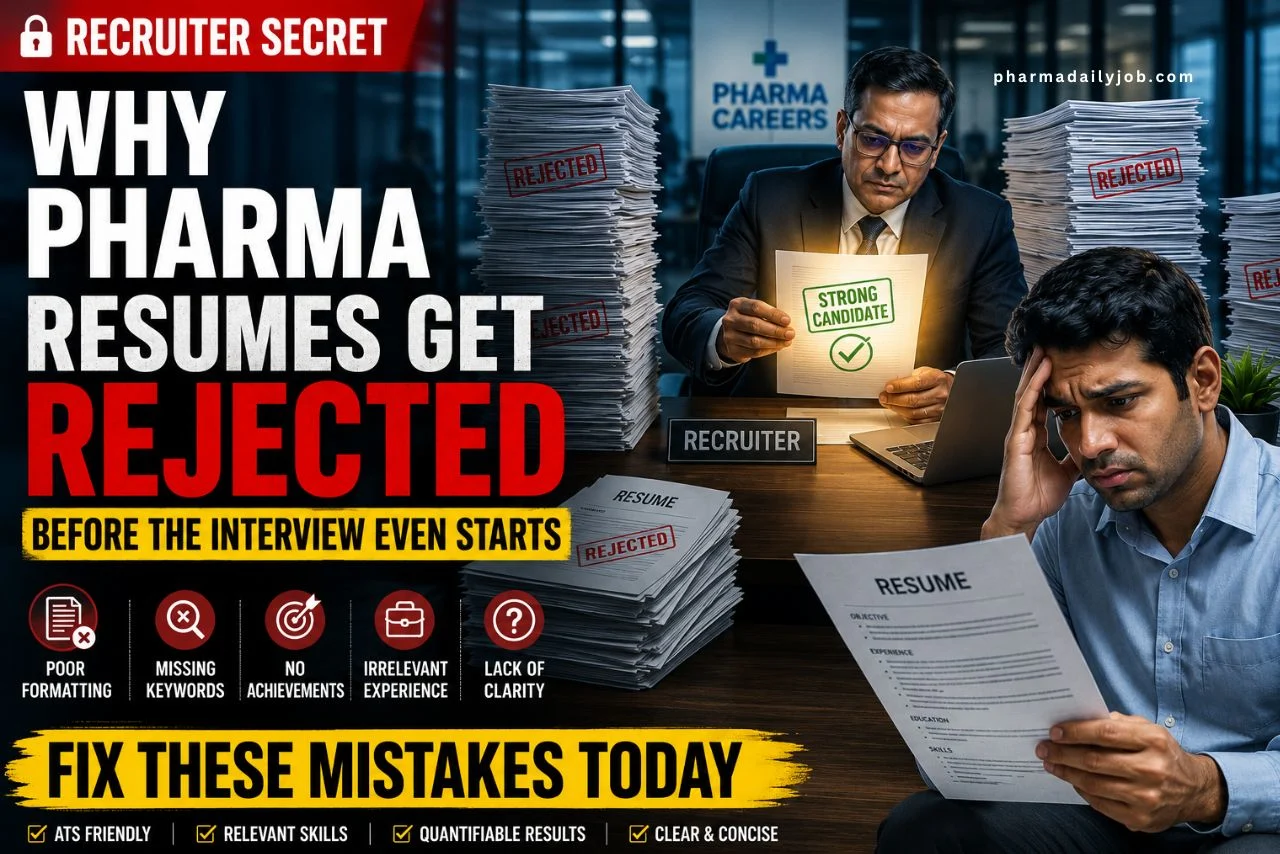
The Hidden Reason Pharma Resumes Get Rejected in 2026 (Even Before the Interview)
You find a job opening that perfectly matches your qualifications.
You update your resume.
You submit the application.
Then you wait.
Days pass.
Weeks pass.
No call.
No email.
No interview.
For many pharma professionals and freshers, this situation feels frustratingly familiar.
Most candidates assume they were rejected because of a lack of experience.
But recruiters often point to a completely different problem.
The resume itself.
Before an interviewer evaluates your technical knowledge, communication skills, or experience, your resume must first convince someone that you deserve an interview.
And in many cases, it doesn’t.
The Shocking Reality
Many pharmaceutical companies receive hundreds of applications for a single position.
Recruiters often spend less than a minute reviewing each resume.
Sometimes even less.
That means your resume must immediately communicate value.
If it doesn’t, your application may never reach the interview stage.
Mistake #1: A Resume That Looks Generic
One of the biggest mistakes candidates make is sending the same resume to every company.
Recruiters can often identify generic resumes instantly.
A resume should reflect:
- Relevant skills
- Relevant experience
- Job-specific strengths
- Industry knowledge
A customized resume often performs significantly better than a generic one.
Mistake #2: Weak Professional Summary
The top section of your resume is extremely important.
Yet many candidates waste this space with vague statements such as:
“Seeking a challenging opportunity in a reputed organization.”
Recruiters see this phrase countless times.
Instead, use the summary to highlight:
- Qualifications
- Technical expertise
- Career interests
- Key strengths
Make recruiters want to keep reading.
Mistake #3: Ignoring GMP and Compliance Knowledge
In the pharmaceutical industry, compliance matters.
Recruiters frequently look for evidence of knowledge related to:
- GMP
- SOPs
- Data Integrity
- CAPA
- Documentation Practices
If you have learned these concepts through training, internships, or certifications, make sure they are visible.
Mistake #4: Listing Responsibilities Instead of Achievements
Many candidates write what they were expected to do.
Few explain what they actually accomplished.
Consider the difference.
Instead of:
“Worked in Quality Control Department.”
Try:
“Assisted in laboratory testing activities and gained exposure to analytical instruments and documentation procedures.”
Specific details create stronger impressions.
Mistake #5: Poor Resume Formatting
A recruiter should be able to scan your resume easily.
Common formatting problems include:
- Large blocks of text
- Inconsistent fonts
- Poor spacing
- Excessive colors
- Unorganized sections
Professional formatting improves readability and credibility.
The Resume Test Most Candidates Fail
Imagine a recruiter reviewing your resume for 20 seconds.
Can they quickly identify:
- Your qualification?
- Your specialization?
- Your experience?
- Your technical skills?
- Your contact details?
If not, your resume may need improvement.
Why Freshers Often Struggle
Freshers frequently believe they have nothing valuable to include.
This is not true.
Recruiters understand that freshers have limited experience.
Instead, focus on:
- Academic projects
- Industrial training
- Certifications
- Technical skills
- Laboratory exposure
- Achievements
Demonstrating potential is often more important than demonstrating experience.
The Resume Mistake That Creates Instant Doubt
Spelling and grammar errors.
A single mistake may seem minor.
However, pharmaceutical companies operate in highly regulated environments where accuracy matters.
Errors can create concerns about attention to detail.
Always proofread your resume carefully before applying.
What Recruiters Actually Want to See
Most recruiters are not searching for perfection.
They want evidence that a candidate is:
- Professional
- Reliable
- Capable of learning
- Technically aware
- Serious about their career
Your resume should communicate these qualities immediately.
A Simple Strategy That Works
Before submitting your resume, ask yourself one question:
“If I were the recruiter, would I call this candidate for an interview?”
Review your resume honestly.
Remove unnecessary information.
Highlight relevant strengths.
Focus on clarity.
The goal is not to impress everyone.
The goal is to earn an interview.
The Candidates Who Get More Calls
Candidates who receive more interview invitations often do three things:
They Customize Their Resume
Every application is tailored to the position.
They Highlight Relevant Skills
Technical knowledge is easy to identify.
They Keep Learning
Certifications, GMP knowledge, and industry awareness help candidates stand out.
Final Thoughts
A resume is more than a document.
It is your first opportunity to convince a recruiter that you deserve attention.
Many pharma candidates lose opportunities before the interview simply because their resumes fail to communicate value effectively.
The good news?
Most resume mistakes are easy to fix.
Small improvements can create a significant difference in the number of interviews you receive.
Before applying for your next pharma job, take another look at your resume.
It may be the most important career investment you make this year.
FAQ
Why do pharma resumes get rejected?
Common reasons include poor formatting, generic content, weak summaries, missing technical skills, and lack of customization.
What should a pharma fresher include in a resume?
Academic projects, industrial training, certifications, technical skills, GMP knowledge, and achievements.
How long should a pharma resume be?
For most freshers and early-career professionals, one to two pages is usually sufficient.
Does resume design matter?
Yes. A clean, professional layout improves readability and creates a stronger first impression.
Link this article to:
- Intas Pharmaceuticals Walk-In Interview 2026 | Biopharma Jobs in Ahmedabad
- Enzene Internship 2026 | Intern – CMA Finance Trainee Program in Pune (15 Months)
- BioMatrix Healthcare Walk-In Interview 2026 | Pharma Jobs in Ahmedabad (Production, QC, ADL & Engineering)
- CorroHealth Walk-In Drive 2026 for Trainee HCC Services | Freshers Job in Noida (3 LPA)
- Lupin Walk-In Interview 2026 | QC & QA Jobs in Vadodara (API Pharma)