
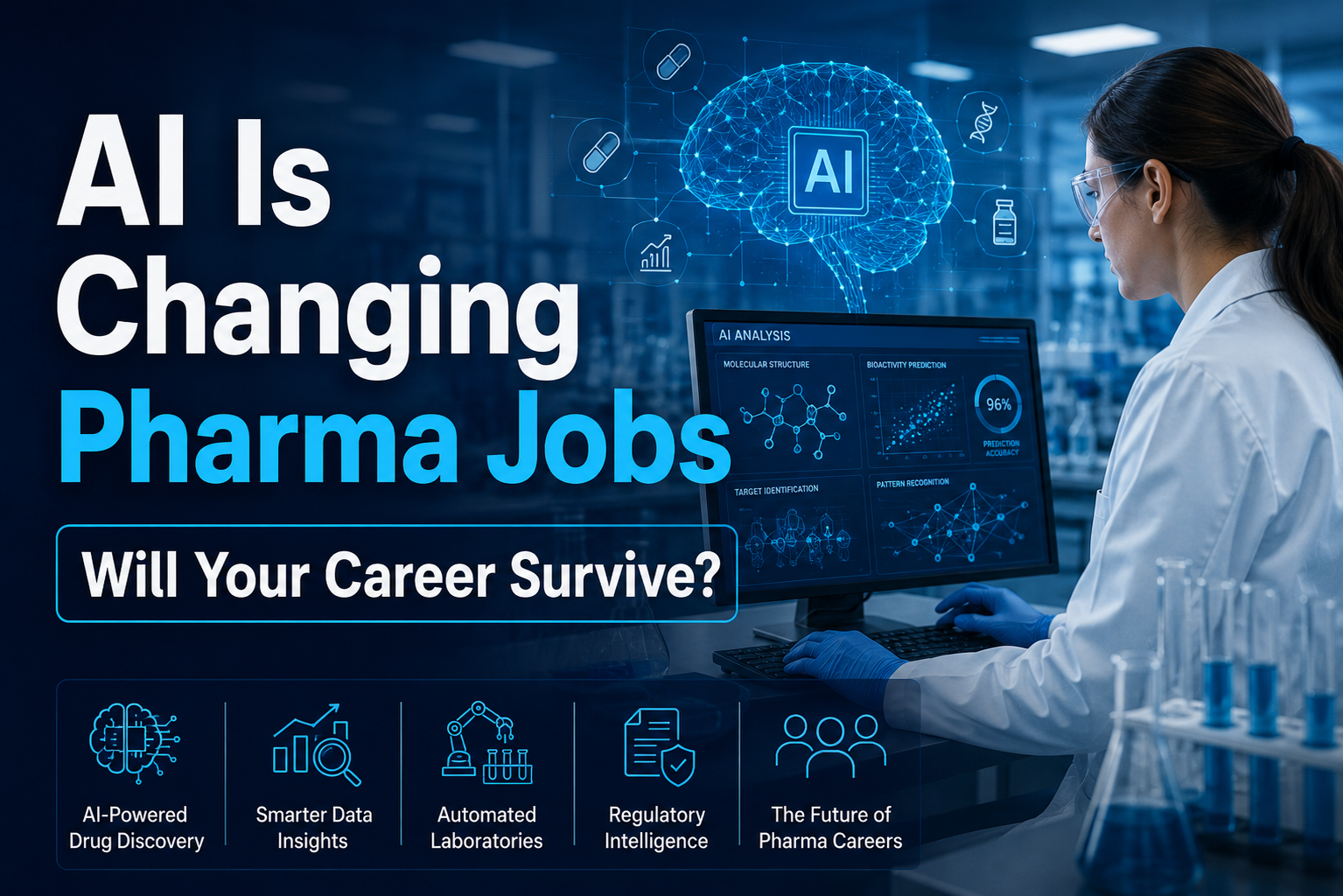
AI Is Changing Pharma Jobs in 2026: Will Your Career Survive the Next 5 Years?
A few years ago, most pharmaceutical professionals believed that automation and artificial intelligence would primarily affect technology companies. Today, that assumption is rapidly changing.
From drug discovery and clinical research to pharmacovigilance and regulatory documentation, artificial intelligence is becoming an important part of the pharmaceutical industry. Companies across the world are investing in AI-powered systems to improve efficiency, reduce costs, and accelerate decision-making. Industry observers expect AI, digital innovation, and data-driven processes to play a larger role in pharmaceutical operations over the coming years.
For many pharma professionals, this creates an important question:
Will AI replace pharma jobs, or will it create new opportunities?
The answer may determine how successful your career becomes over the next decade.
The Biggest Mistake Pharma Professionals Are Making
Many professionals assume that experience alone will protect their careers.
However, pharmaceutical companies are increasingly looking for employees who can combine scientific knowledge with digital skills. Organizations are adopting technologies that support clinical research, compliance, documentation, manufacturing, and data analysis.
The professionals who adapt early may have a significant advantage over those who ignore these changes.
Pharma Roles That Could Grow Faster Because of AI
1. Pharmacovigilance
Drug safety remains a critical priority for pharmaceutical companies.
As the volume of safety data increases, companies are investing in advanced systems that help process and analyze information more efficiently. The global pharmacovigilance market is projected to continue growing strongly over the coming years.
2. Regulatory Affairs
Global regulations continue to become more complex.
Regulatory professionals who understand compliance, documentation, and digital systems are expected to remain highly valuable.
3. Clinical Research
Clinical research is evolving beyond traditional monitoring roles.
Experts increasingly discuss AI-assisted trials, advanced analytics, and technology-enabled research processes.
4. Data-Driven Quality Assurance
Quality professionals who can work with digital systems, analytics, and compliance tools may become increasingly important.
5. Medical Writing
AI can assist with drafting content, but pharmaceutical companies still require skilled professionals who can review, validate, and ensure scientific accuracy.
Skills That May Become More Valuable in 2026 and Beyond
Instead of fearing AI, pharma professionals should focus on developing complementary skills:
- GMP and Compliance Knowledge
- Data Integrity
- Regulatory Affairs
- Clinical Research
- Pharmacovigilance
- Documentation Excellence
- Data Analysis
- Critical Thinking
- Communication Skills
- Problem Solving
These capabilities are difficult to replace because they require scientific judgment and regulatory understanding.
A Career Lesson Many Professionals Learn Too Late
Imagine two professionals starting their careers at the same time.
The first focuses only on routine tasks.
The second continuously learns new technologies, understands industry trends, and develops specialized expertise.
Five years later, their career paths can look completely different.
The pharmaceutical industry has always rewarded professionals who adapt to change. AI is simply the next major shift.
What the Future Looks Like
Healthcare and pharmaceutical sectors continue to show strong hiring activity, while innovation, digital transformation, and research investment create new opportunities for skilled professionals.
The question is no longer whether AI will influence pharma careers.
The real question is:
Will you be prepared when it does?
Final Thoughts
Artificial intelligence is unlikely to eliminate the need for pharmaceutical professionals. However, it is changing the skills employers value most.
The next generation of successful pharma professionals will combine scientific expertise with digital awareness, regulatory knowledge, and adaptability.
Those who continue learning may discover that AI becomes one of the biggest career opportunities the industry has seen in years.
Link this article to:
- ECHS Pharmacist Recruitment 2026 – Government Job at Erode (₹36,500 Salary | Apply Before 15 June)
- Virchow Biotech Walk-In Interview 2026 – Manufacturing, Engineering, QA & QC Jobs in Hyderabad
- Intas Pharmaceuticals Walk-in Week 2026 – Injectable, OSD & Engineering Jobs in Ahmedabad
- Virchow Biotech Walk-In Drive 2026 – Manufacturing QC & QA Injection Moulding Jobs in Hyderabad
- Lupin Walk-In Drive 2026 – Production, QC & QA Jobs in Tarapur | Apply Now
FAQ
Will AI replace pharma jobs completely?
Current industry trends suggest AI is more likely to transform jobs and workflows rather than completely replace most pharmaceutical roles.
Which pharma fields have strong future demand?
Regulatory Affairs, Pharmacovigilance, Clinical Research, Quality Assurance, and Data-Driven Compliance are often highlighted as growth areas.
What skill should pharma freshers learn first?
A strong foundation in GMP, documentation, compliance, communication, and digital tools can provide a competitive advantage.